


A new generation of hearing protection is opening up new space
Hearing protection isn't a new category — it's a well-established one, built around a simple, decades-old idea: block the sound. What's new is the generation of device now emerging inside that category. Established PPE brands have started adding Bluetooth connectivity and audio pass-through to product lines that were, until recently, purely passive, and features borrowed directly from medical hearing aids — transparency (hear-through) mode and wide dynamic range compression (WDRC) — are now showing up in devices built for occupational and recreational noise exposure rather than hearing loss. That's the real shift: hearing protection is absorbing hearing-aid-grade technology, not turning into a different market.
That shift is the opportunity and the difficulty at the same time. A safety brand adding this generation of features needs consumer- and medical-grade acoustic engineering it may not have in-house. A hearing-aid or consumer-audio team moving into protection needs to hit a hard, independently-tested safety ceiling it has never had to design for. Lyratone's platform is built to cover both halves of that gap.
The architecture
Every OWS algorithm on this page runs on that architecture — SDH makes it programmable, AI makes it intelligent.
The Foundation
Software-Defined Hearing
The Evolution
AI-Defined Hearing
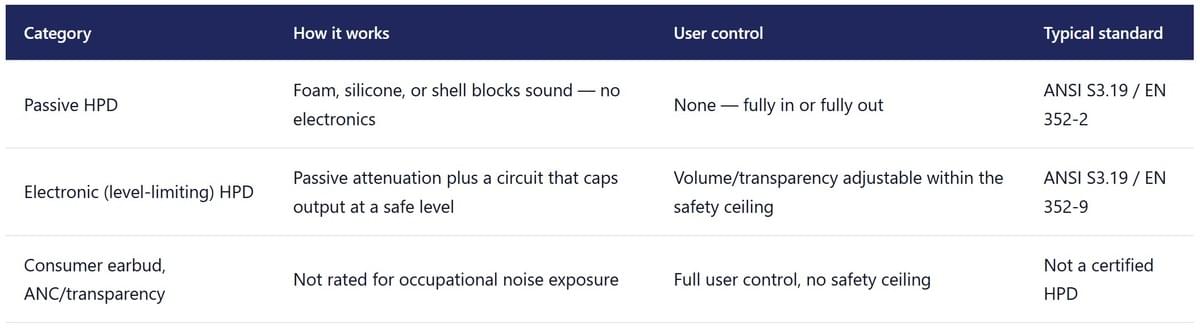
What counts as hearing protection
"Hearing Protection Device (HPD)" is the standard term used by OSHA, NIOSH, and the EPA — worth using precisely, since "ear protection" and "noise-cancelling" mean different things to a safety buyer.
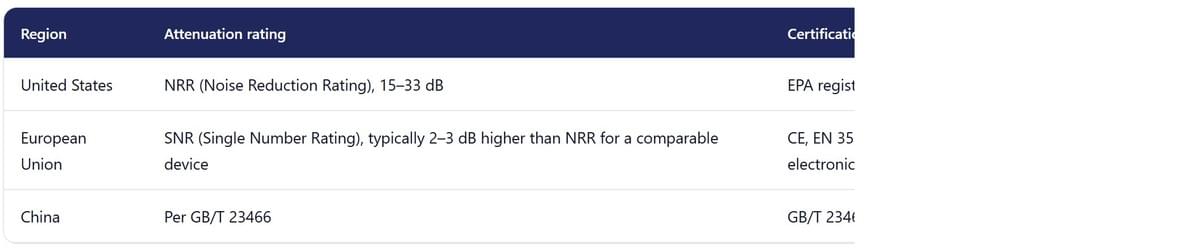
The regulatory landscape
Three regions, three test methods, one underlying idea — cap the sound reaching the ear at a safe level, and prove it with a recognized rating.Add paragraph text here.
The output-limiting ceiling most of the industry designs to is 82 dB SPL — regardless of how loud the surrounding environment is, the electronic system will not pass sound above that level into the ear. That threshold is adjustable in Lyratone's implementation, but the safety logic itself is non-negotiable: it caps output before anything else happens.
Three problems that keep most teams out of this category
A hard safety ceiling and a natural listening experience pull against each other. The 82 dB output cap can't be compromised — protection isn't real if a transient noise spike slips past it. But the comparison point users bring to any modern earbud is a premium consumer product: low latency, wide frequency response, clear pass-through, natural dynamics. Limiting and fidelity are, to a real degree, in tension — push the limiter harder and dynamics and naturalness suffer; optimize purely for natural sound and transient spikes risk breaking the ceiling. Most industrial PPE teams are strong on the first half; most consumer-audio teams are strong on the second. Few teams have had to be excellent at both at once.
Global certification is fragmented. The US EPA/ANSI framework, the EU's CE/EN 352 framework, and China's GB/T 23466 + CCC framework each define test methodology, attenuation metrics, and output limits slightly differently. A device meant to sell in all three markets still has to be engineered and tested to meet each region's requirements in full — there's no shortcut around any of the three regimes. What Lyratone's software-defined platform changes is how much new engineering that takes: the same hardware base can be configured and tuned in software to properly meet each region's distinct attenuation and output-limit requirements, so bringing a new market's certification online is a software configuration effort on a proven hardware platform, not a new hardware program built from scratch.
Every physical structure needs its own acoustic model. An in-ear tip, an ear-hook, and a clip-on each interact with sound differently, so an acoustic model tuned for one physical structure won't perform correctly in another — historically, that's meant a new acoustics development cycle for every new industrial-design shape. Because Lyratone's platform is software-defined, we can take an existing earbud ID and mechanical structure and adapt the acoustic model in software to meet that structure's specific hearing-protection requirements, instead of re-engineering hardware for every new form factor.
Specifications — Lyratone reference design
Output limiting
Attenuation — standard tip (9.5mm)
Attenuation — extended tip (14mm)
Self-noise, lowest volume setting
Volume / transparency control
Connectivity
82 dB SPL (adjustable to customer requirement)
EN 352-2 SNR ≈ 46 dB
EN 352-2 SNR ≈ 50 dB
24.3 dBA
5 user-adjustable levels
Bluetooth 5.4
Pass-through frequency response, phase behavior, self-noise, and distortion were validated end-to-end in an anechoic chamber against an IEC 711 coupler, benchmarked directly against a leading consumer TWS reference product rather than against a passive-earplug baseline — the goal from day one was a listening experience that doesn't feel like protective equipment.
Who this is for
The teams best positioned to define this category early.
Industrial PPE
ODM and brands
Teams with an established passive product line looking to add electronics and move into consumer-facing retail channels.
Outdoor sport & shooting sport
ODM and brands
Users who need "protected, but can still hear a companion talk" as a core use case — among the earliest paying adopters of electronic protection.
How you can work with us
Software — LyraOS
License the OWS algorithm suite — feedback suppression, bass enhancement, WDRC — into hardware you already control.
PCBA module — LyraCore
Algorithm and chipset integration on one board, tuned for open-ear acoustics, ready to drop into your industrial design.
Full device — LyraHearing
A certified, ready-to-brand OWS device — clip-on or ear-hook — so you can launch without building a hearing-technology team.
Built on an IP-independent platform
Lyratone's OWS algorithms are self-developed and independently patented, built on the same architecture that powers our prescription and hearing-protection lines: Software-Defined Hearing as the foundation, AI-Defined Hearing as the evolution. That means your OWS product keeps improving through software updates rather than a hardware redesign — and it means you're never one licensing renewal away from losing the technology your product is built on.
See why an IP-independent partner matters →
