• Cartilage Conduction Hearing

    the third auditory pathway for medical-grade clarity—open-ear, non-invasive, pressure-free

    Lyratone’s full-stack IP powers cartilage conduction with medical-grade clarity

  • Cartilage Conduction Hearing Aid (CCHA)

    A Cartilage Conduction Hearing Aid (CCHA) is a hearing device based on a unique sound transmission mechanism known as the "third auditory pathway," which is distinct from traditional air and bone conduction.

    How it works (3 pathways)

    Cartilage–Air (Primary): cartilage vibration creates sound inside the ear canal → eardrum → cochlea

    Cartilage–Bone: vibration travels via cartilage to skull bone → cochlea

    Direct Air: a small portion radiates from the vibrator into the ear canal

    Cartilage conduction hearing aids mainly benefit people with conductive hearing loss, including those with ear canal atresia or malformation, chronic middle-ear disease, ear discharge, or post-surgical ear conditions, as well as patients with conductive-dominant mixed hearing loss and usable cochlear function. They are also well suited for children and unilateral hearing-loss cases where surgery or traditional bone-conduction devices are not ideal.

    In addition, because cartilage conduction devices are open-ear and do not require in-ear insertion, they provide much better ventilation and comfort, reduce irritation and infection risk, and are especially suitable for long-time daily wearing compared with conventional in-ear air-conduction hearing aids.

  • Differences: Cartilage Conduction vs. Traditional Air and Bone Conduction
    Section image

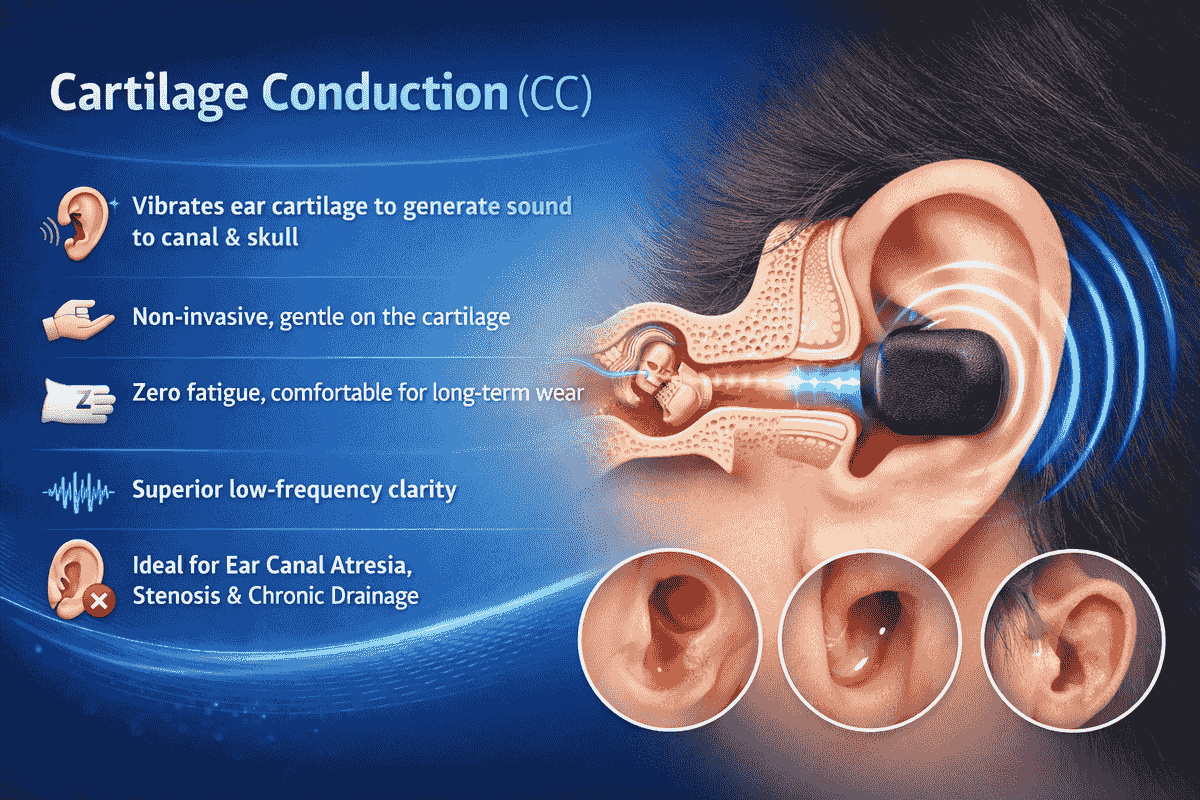
    Cartilage Conduction (CC)

    • Vibrates ear cartilage to generate sound in the canal and skull
    • Non-invasive; vibrator is placed gently against the cartilage.
    • Zero fatigue; comfortable for long-term wear with no pressure.
    • Superior low-frequency clarity compared to bone conduction.
    • Users with ear canal atresia, stenosis, or chronic drainage.
    Section image

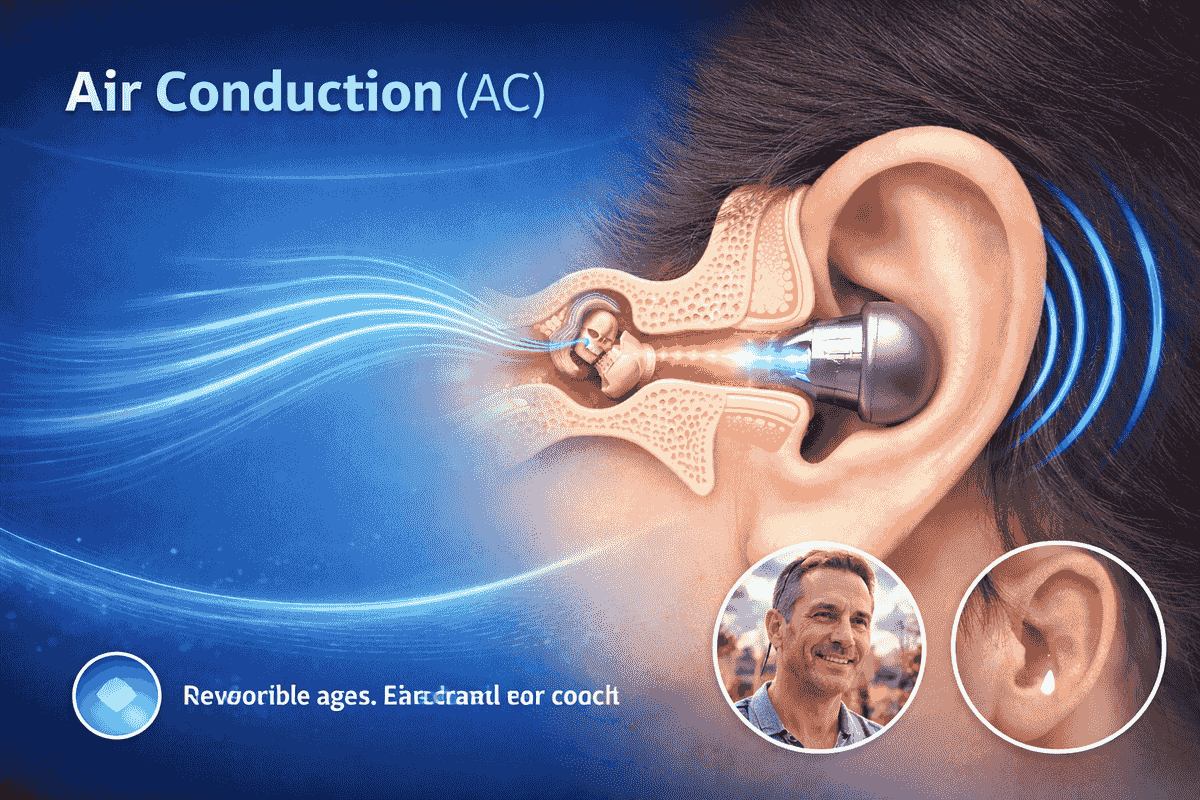
    Air Conduction (AC)

    • Amplifies airborne sound waves through the ear canal to the eardrum.
    • Non-invasive.
    • Can cause ear canal discomfort or "occlusion effect" (blocked feeling).
    • Most natural for healthy ear canals.
    • Users with open, functional ear canals.
    Section image

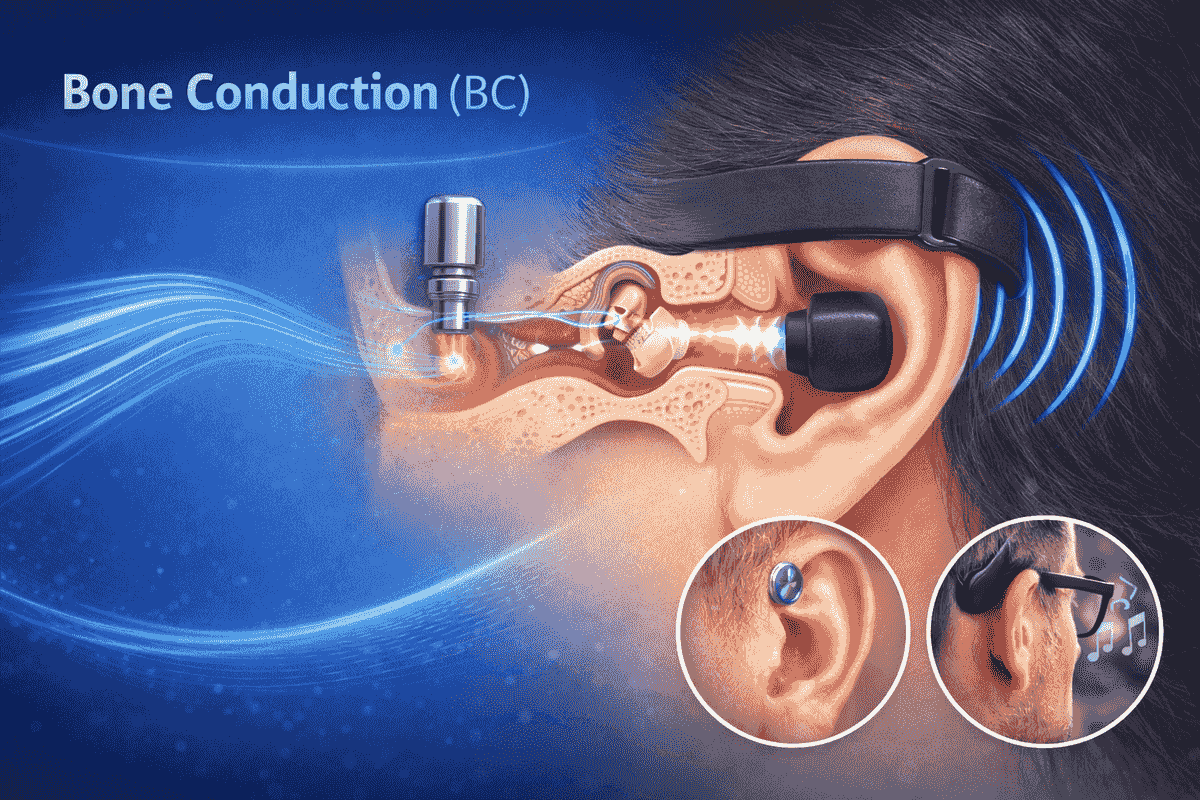
    Bone Conduction (BC)

    • Vibrates the skull bone to stimulate the cochlea directly.
    • Often requires surgical implants (BAHA) or high-pressure headbands.
    • High pressure on skin or risks associated with surgery.
    • Poor low-frequency response and prone to feedback.
    • Users with conductive loss who accept surgery or pressure.
  • Lyratone’s Advantage in Cartilage Conduction Solutions

    Lyratone is a global leader in the development of next-generation Cartilage Conduction (CC) solutions, leveraging the "third auditory pathway" to provide a non-invasive, zero-fatigue listening experience. Our competitive advantage is defined by two core pillars:

    • Full-Stack Independent Intellectual Property: Lyratone possesses completely independent and controllable IP across the entire technical chain—encompassing core algorithms, chip application, hardware design, and fitting systems—with a technology self-sufficiency rate exceeding 90%. This end-to-end IP ownership ensures that our partners are not restricted by third-party black-box technologies and can achieve deep, medical-grade customization.
    • SDH Architecture for Unique Acoustic Flexibility: While traditional hearing aids rely on rigid ASIC chips designed specifically for air conduction, Lyratone utilizes its pioneering Software-Defined Hearing (SDH) architecture to bridge the gap. This framework provides the essential flexibility required to adapt core processing algorithms to the unique acoustic structure of cartilage vibration. By decoupling software from hardware, Lyratone can precisely tune 32-128 channel WDRC and feedback management specifically for the CC pathway, enabling high-gain performance and superior sound clarity that can be iterated via software updates in weeks rather than years.

  • Why choose Cartilage Conduction Hearing Aid

    1

    Key Clinical Advantages

    • Non-Invasive & Zero Fatigue
    • Open-Ear Ventilation
    • Acoustic Fidelity
    • Improved Sound Localization
    2

    Primary Indications

    • Congenital Aural Atresia or Microtia
    • External Auditory Canal Stenosis
    • Persistent Otorrhea
    • Mixed or Conductive Hearing Loss
    3

    The Lyratone Edge in Cartilage Conduction

    Lyratone combines SDH with high-performance cartilage vibrators to deliver cartilage-tuned WDRC, rapid software upgrades, and AI personalization beyond hardware-fixed systems.